
A Legal and Practical Guide for Foreign Investors Entering Vietnam’s F&B Industry
BUSINESS GUIDE
1/27/20263 min read
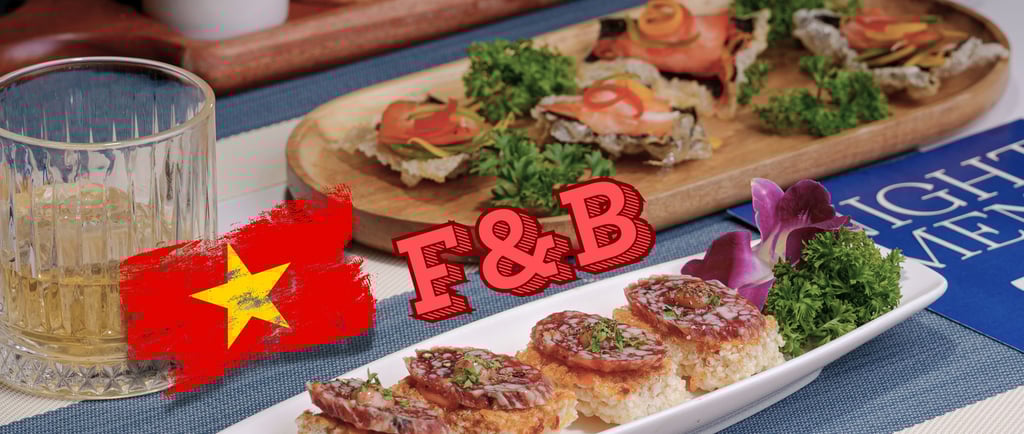

Vietnam’s food and beverage (F&B) industry is one of the country’s fastest-growing sectors, supported by rising incomes, rapid urbanization, and strong tourism demand. Often described as a “hotbed of opportunity,” the market offers significant potential—but success depends on careful compliance with Vietnam’s legal and regulatory framework.
This guide provides foreign investors with an overview of the key legal, licensing, and operational requirements for entering Vietnam’s F&B sector. It covers company setup, permits, food safety rules, labeling standards, ownership conditions, and practical strategies to reduce regulatory risk.
1. Market Entry and Company Formation
Foreign investors entering Vietnam’s F&B market must comply with the Law on Investment and the Enterprise Law. In most cases, market entry involves three main steps:
Investment Registration Certificate (IRC)
Enterprise Registration Certificate (ERC)
Sector-specific operational licenses
Investment Registration Certificate (IRC)
The IRC is issued by the provincial Department of Planning and Investment (DPI) or an Economic Zone authority. It formally approves the investment project and is generally required for foreign-owned ventures.
Enterprise Registration Certificate (ERC)
Once the IRC is granted, investors apply for the ERC to legally establish the Vietnamese company. The ERC serves as the core business registration document and is typically valid indefinitely.
Timeline note:
Straightforward projects may take 1–2 months, while larger-scale food manufacturing or franchising projects may require additional ministry-level approvals.
2. Business Licensing for F&B Operations
Beyond incorporation, F&B businesses must obtain operational permits before launching.
Key Required Licenses
Most restaurants, cafés, and food manufacturers must secure a Certificate of Food Safety Conditions (CFSC) issued by local health authorities.
Additional approvals often include:
Fire Safety Certification (after inspection)
Environmental and sanitation clearance
Signboard and advertising permits
Liquor license (if alcohol is sold)
Import/export registration (for imported food products)
Imported processed foods must often be registered with the Vietnam Food Administration (VFA) and may require a Certificate of Conformity Declaration (CCD) before entering the market.
Practical tip:
Investors should allow 2–6 weeks after ERC issuance to complete licensing and inspections.
Failure to obtain the correct permits can result in fines, suspension, or forced closure—making early preparation essential.
3. Food Safety Compliance Requirements
Vietnam enforces strict food safety regulations under the Law on Food Safety, supervised by the Ministry of Health (MOH) through the Vietnam Food Administration (VFA).
Both manufacturers and food service operators must comply with standards covering:
hygiene and sanitation
ingredient sourcing
permitted additives
storage and distribution controls
recall responsibility
Key Compliance Areas
Ingredient and additive controls
Vietnam maintains strict lists of permitted additives and residue limits. Non-compliance may lead to product seizure or import refusal.Facility licensing
Food factories may require production licenses confirming compliance with GMP standards.Regular inspections
Authorities conduct both scheduled and surprise inspections. Businesses should maintain documentation and conduct internal audits.Recall and liability exposure
Companies are legally responsible for foodborne illness risks, making recall plans and insurance strongly recommended.
4. Labeling Rules for Domestic and Imported Products
Vietnam requires all packaged food sold locally to carry Vietnamese-language labels, including:
product name
ingredients
net weight
expiration date
manufacturer/importer details
nutrition information (where applicable)
Imported products may also require additional testing or registration.
Common investor mistake:
Underestimating labeling complexity. Many foreign brands face delays due to translation errors or incomplete compliance.
Recommendation:
Engage local consultants early and budget for professional labeling review.
5. Foreign Ownership and Market Access
The majority of Vietnam’s F&B sector is fully open to foreign investment.
Under WTO commitments and Vietnamese investment law:
Restaurants, cafés, catering, and food production generally allow 100% foreign ownership
Local partners are not legally required in most F&B segments
Areas to Monitor
Distribution and retail expansion may trigger additional regulatory review
Franchising requires registration with the Ministry of Industry and Trade (MOIT)
Certain specialized sub-sectors (aquatic products, herbal goods) may involve additional approvals
Location approval and land-use zoning can also affect restaurant and factory setup, even where ownership is unrestricted.
6. Practical Challenges and Investor Strategies
Best-Practice Recommendations
Work with experienced local advisors to navigate licensing and provincial requirements
Implement HACCP or ISO food safety systems from the beginning
Register trademarks early to prevent copycat branding
Plan carefully for labor turnover, which is common in hospitality
Maintain tax and invoice compliance, especially under Vietnam’s strict e-invoicing regime
Common Market Challenges
Complex regulatory overlap across ministries
Infrastructure gaps outside major cities (cold chain, utilities)
Intense competition from strong local brands and global franchises
Language and cultural barriers affecting contracts, labeling, and operations
Successful foreign entrants typically invest in strong local teams, compliance systems, and market adaptation.
Conclusion
Vietnam’s food and beverage industry offers high-growth potential for foreign investors, supported by strong consumer demand and an increasingly open investment environment. However, entering the market requires thorough preparation, including:
proper licensing (IRC, ERC, food safety permits)
compliance with food safety and labeling laws
careful site planning and operational readiness
long-term attention to labor, tax, and branding protection
With strong compliance planning and local expertise, foreign investors can build sustainable and profitable F&B ventures in Vietnam.
Expert support for your business in Vietnam.
© 2026. All rights reserved.